“He descended into Hell” – Notes on “The Harrowing of Hell”

Quiet day, as befitting Holy Saturday.  All is quiet in the Church as Christ’s soon to be reclaimed Body is in the tomb while His human fused divinity harrows Hell.

Starting with some citations in the New Testament we pry open what came to be known as the “harrowing” or “raid” of Hell, what Christ did between His death on the Cross and His resurrection.

Originally, the English word “harrow” has to do with preparing ground for tilling.  “Harrowing” involved drawing a kind of grate with downward spikes over the ground to break it up.    Here’s an image from a 16th c Book of Hours:

After the Council Trent was closed, the Roman Catechism was issued in 1566.  It was intended especially to shore up the fundamental doctrine of the clergy and be an aid for pastoral preaching.  I take my title for the columns I post at One Peter Five from Trent, which says that sermons should be giving “at least on Sundays”.

The Catechism explains with characteristic clarity the articles of the Apostle’s Creed and therefore what the “harrowing of Hell” was and why Christ did it.

The Roman Catechism states that after His death Christ’s soul, in no way diminished, descended into Hell in solidarity with man not to suffer, but to “liberate the holy and the just from their painful captivity, and to impart to them the fruit of His Passion.”

The Catechism then says, “Having explained these things, the pastor should next proceed to teach that …”, … and here let me fulfill the Catechism’s directive,…

Christ the Lord descended into Hell, in order that having despoiled the demons, He might liberate from prison those holy Fathers and the other just souls, and might bring them into heaven with Himself. This He accomplished in an admirable and most glorious manner; for His august presence at once shed a celestial lustre upon the captives and filled them with inconceivable joy and delight. He also imparted to them that supreme happiness which consists in the vision of God, thus verifying His promise to the thief on the cross: This day thou shalt be with me in paradise.  […]  But the better to understand the efficacy of this mystery we should frequently call to mind that not only the just who were born after the coming of our Lord, but also those who preceded Him from the days of Adam, or who shall be born until the end of time, obtain their salvation through the benefit of His Passion. Wherefore before His death and Resurrection heaven was closed against every child of Adam. The souls of the just, on their departure from this life, were either borne to the bosom of Abraham; or, as is still the case with those who have something to be washed away or satisfied for, were purified in the fire of purgatory.

One artistic representation I thoroughly enjoy is that the Blessed Fra Angelico.  The Roman Catechism says Christ “despoiled the demons”.   Note what’s under the door Christ has blasted down.  You can right click for a larger version.

Out comes old Adam, first of all, to the New Adam.

That sure reference work for the Catholic faith issued in 1997 in the Latin typical edition (1994 in French), the Catechism of the Catholic Church, covers this article of the Creed in par. 632ff.  The first meaning applied to this phrase was that “Jesus, like all men, experienced death and in his soul joined the others in the realm of the dead. But he descended there as Savior, proclaiming the Good News to the spirits imprisoned there” (632).

The place Christ went, the abode of the dead, biblical sheol, is where the none of the dead can see God, regardless of their wickedness or righteousness. Christ descended into sheol to liberate the righteous dead, not the damned.   Thus, the “the Author of life”, by dying destroyed “him who has the power of death, that is, the devil” (635).  Furthermore, as we read in an ancient Holy Saturday sermon in Greek (included in the Office of Readings of the Liturgy of the Hours),

He has gone to search for Adam, our first father, as for a lost sheep. Greatly desiring to visit those who live in darkness and in the shadow of death, He has gone to free from sorrow Adam in his bonds and Eve, captive with him – He who is both their God and the son of Eve.

This article of the Creed underscores Christ as the Second Adam, making right the damage worked by the First Adam in the original sin of our first parents.

It may be that an element of ancient mythologies influenced the telling of this doctrine of the Apostolic Church.  Down through the centuries this idea of the “harrowing of Hell” fueled the imagination of Christians and their theological reflection resulting in apocryphal “gospel” accounts, medieval mystery plays, and works of art such as Eastern icons.  There is something paradoxical in the core of the doctrine, namely, that our God, in an indestructible bond with our humanity, might go to Hell, even if for a brief and specific mission.

In early Christian apocrypha, such as the Greek fourth century Acts of Pilate or the Latin medieval Gospel of Nicodemus there were imagined dialogues between the King of Glory, Christ, and the Prince of Hades, Satan.  In the medieval period, particularly from 13-16th  century England, there were performances of mystery plays, including of course the dramatic “harrowing of Hell”.   Mystery plays were an important force in the revival of modern theatre.  The 13th century Aurea Legenda or Golden Legend compiled by Jacob de Voragine (+1298) includes the tale.

Dante in the Divine Comedy has Virgil give the poet an eyewitness account (Inf 4,52-63).

rispuose: “Io era nuovo in questo stato,
quando ci vidi venire un possente,
con segno di vittoria coronato.54Trasseci l’ombra del primo parente,
d’Abèl suo figlio e quella di Noè,
di Moïsè legista e ubidente;57

Abraàm patrïarca e Davìd re,
Israèl con lo padre e co’ suoi nati
e con Rachele, per cui tanto fé,60

e altri molti, e feceli beati.
E vo’ che sappi che, dinanzi ad essi,
spiriti umani non eran salvati”.

Replied: “I was a novice in this state,
When I saw hither come a Mighty One,
With sign of victory incoronate.Hence he drew forth the shade of the First Parent,
And that of his son Abel, and of Noah,
Of Moses the lawgiver, and the obedient

Abraham, patriarch, and David, king,
Israel with his father and his children,
And Rachel, for whose sake he did so much,

And others many, and he made them blessed;
And thou must know, that earlier than these
Never were any human spirits saved.”

In Eastern iconic depictions of the mystery, you see the risen Lord in luminous garb, carrying a Cross, trampling broken doors.   (See also the Fra Angelico, above.) He extends His hand, sometimes to an old man, Adam, or to others below in a cave or tomb-like grotto.  Sometimes we see Dismas, the Good Thief, to whom Christ promised salvation that very day as they were crucified together.  In renaissance frescoes and paintings the same themes continue, but often with the dramatic addition of irritated devil onlookers, probably echoes in paint of the mystery plays common to the era.

Through the ages up to our own day in the Easter vigil liturgy in the Eastern Churches, Catholic and Orthodox, a sermon known simply as “The Easter Sermon” attributed to St. john Chrysostom (+407) is read, often with dialogue-like participation of the congregation (not “assembly”).  Here is an excerpt:

Let no one fear death, for the Death of our Savior has set us free.
He has destroyed it by enduring it
He destroyed Hades when He descended into it
He put it into an uproar even as it tasted of His flesh
Isaiah foretold this when he said
“You, O Hell, have been troubled by encountering Him below.
Hell was in an uproar because it was done away with
It was in an uproar because it is mocked.
It was in an uproar, for it is destroyed
It is in an uproar, for it is annihilated
It is in an uproar, for it is now made captive.
Hell took a body, and discovered God.
It took earth, and encountered Heaven.
It took what it saw, and was overcome by what it did not see.
O death, where is thy sting?
O Hades, where is thy victory?

The “harrowing of Hell”, however it took place and however it may be depicted, is an doctrine of faith to which as Christians we give assent.  The central point of this article of the Creed is that the Christ in His atoning Sacrifice has free us from the eternal bonds of death in sin, liberated us from the fear of unavoidable everlasting separation from God.

Whether in our recitation of the Holy Rosary or during Holy Mass, every time you say “he descended to the dead” and in the newer version “he descended into Hell”, do so with hope in your heart and firm belief that Christ’s Sacrifice freed you from the inevitability of Hell.
STOP! Look at this: “What Are Synods Good For?” (AUDIO)

Take a few minutes – right now, not later – and read the piece over at the ever valuable The Catholic Thing by my old friend Msgr. Hans Feichtinger. This is outstanding in its perspicacity and in its concision. There is hardly a word wasted (which is good because the policy of The Catholic Thing is to keep their daily offerings under 1000 words).

I’m going to presume on my friendship with both Msgr. Feichtinger and the editor of TCT Robert Royal and read this piece for you, so that you can listen to it easily in your car or elsewhere… perhaps several times.   Their webpage has a button to hear a computer generated reading but I think I will be able to manage a slightly more interesting recitation.

A taste:

What Are Synods Good For?

[…]

The very idea that evangelization needs more synodality is, in fact, questionable. Evangelization needs witness, prophecy, holiness. For synods to have a place in the work of evangelization, they need to stay away from political ways of thinking.

When people engage in a lot of Church sociology, it’s a sure sign of being stuck in a confused nostalgia about Christendom, and in approaches that have been failing for some decades: pace Cardinal Radcliffe, but the reasons why bishops, clergy and laity in Africa (and not only there) reject Fiducia supplicans are deeply biblical and doctrinal, not “pressure” they feel from Orthodox, Protestant or Muslim groups in their countries, bolstered by Russian, American, or Arab money.

Such a statement is theologically shallow, and Marxist in its reductionism of all things to power and money. On closer inspection, it’s even a kind of a conspiracy theory and/or a projection. The pressure from people with power, influence and money, endlessly pushing an LGBT agenda, is much stronger in North America and Europe. This ideological colonization is by now exhausting even the papal patience.

[…]

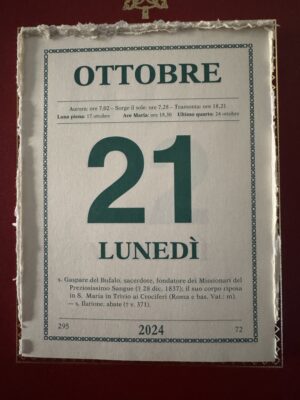
Rome 24/10 – Day 20 & 21: Hammer of Freemasons

The beautiful blue Roman sky was today illuminated at 07:28.  It will darken considerably after 18:21.   The Ave Maria is now in the 18:30 cycle in the Roman Curia, if they did anything over there.

Thank you, Lord, for this day.

This day is also the Feast of St. Gaspar del Bufalo (+1837), known as the “Hammer of Freemasons”.   A great title.

I have interest in St. Gaspar as one of my Roman patrons because I exercised ministry as a seminarian and then deacon at the basilica in Rome where he helped to found devotion to and the Confraternity of the Most Precious Blood at San Nicola in Carcere.   He had a tense relationship with the state (Napoleon’s police were after him). Masons tried multiple times to assassinate him… as they do. His answer to the French commissar asking him to sign his submission to emperor should be the motto of every pope and bishop requested to yield to the world:

“I can’t, I musn’t, I don’t want to.”

That’s how a Roman priest says ‘No’ when he wants to be talkative.”

It’s better in Italian.

‘Non posso, non debbo, non voglio!’

I wonder if Pius VII’s “Non debemus, non possumus, non volumus” didn’t come from St. Gaspar.  I’ll bet it did.

These days it’s more like, “Volumus! Possumus! Debetote etiam vos!”   Anything to appease the secular realm.

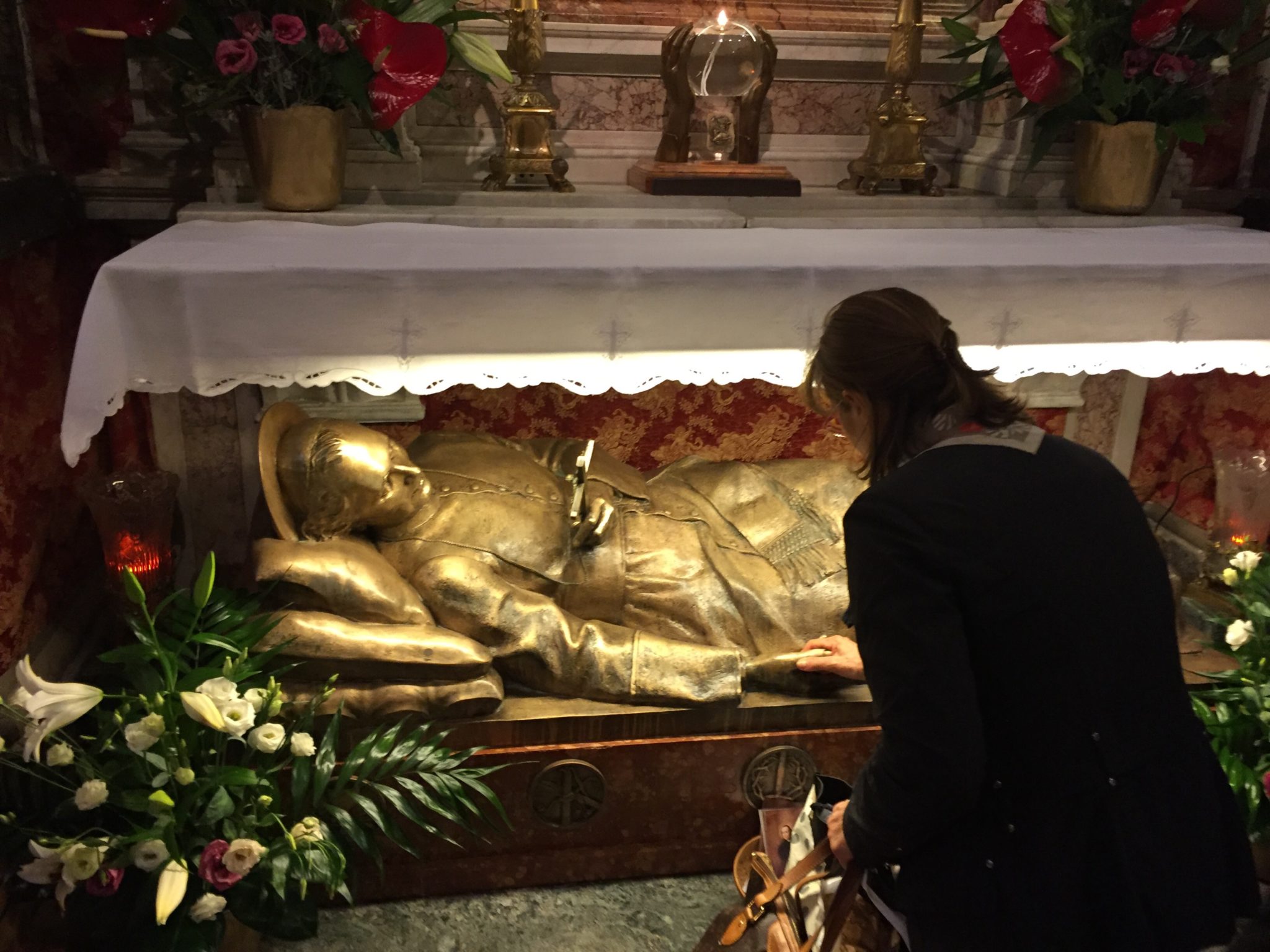
St Gaspar’s tomb is in the little S. Maria in Trivio, tucked away behind where the flashy Trevi Fountain.  His bronze tomb has no barrier and the hand of the image of the saint is extended outward so that you can grasp it.  It is quite moving.

St. Gaspar had ways that really could irritate, as many saints.  For example, he could sense satanic objects and would charge into peoples homes to seize and destroy them no matter how well hidden.  When he was young, he grew up across the mighty Church of the Gesù where his father was a cook at the Altieri palace.  When Gaspar was very young he had a malady of the eyes that threatened blindness.  He was cured through the intercession of St. Francis Xavier, whose arm is in the Gesù.  As a priest of Rome he was critical of the Papal States which got him into hot water.  The Pope had confidence in him, and asked him to engage in charitable works.

St. Gaspar, Hammer of Freemasons, pray for us.

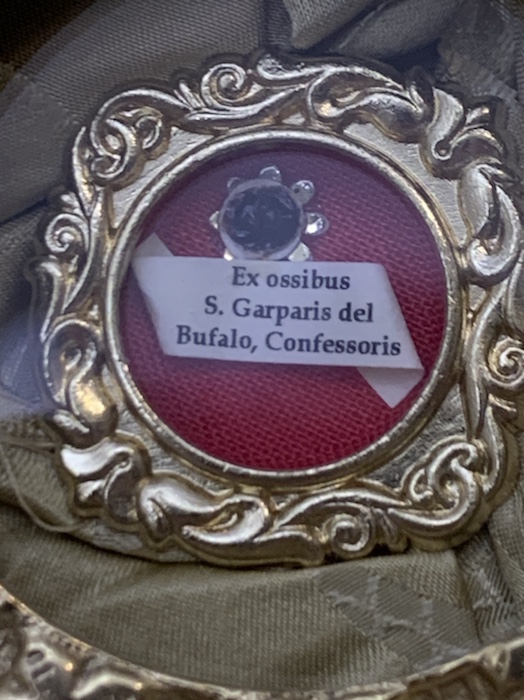
My 1st class relic of St. Gaspar.

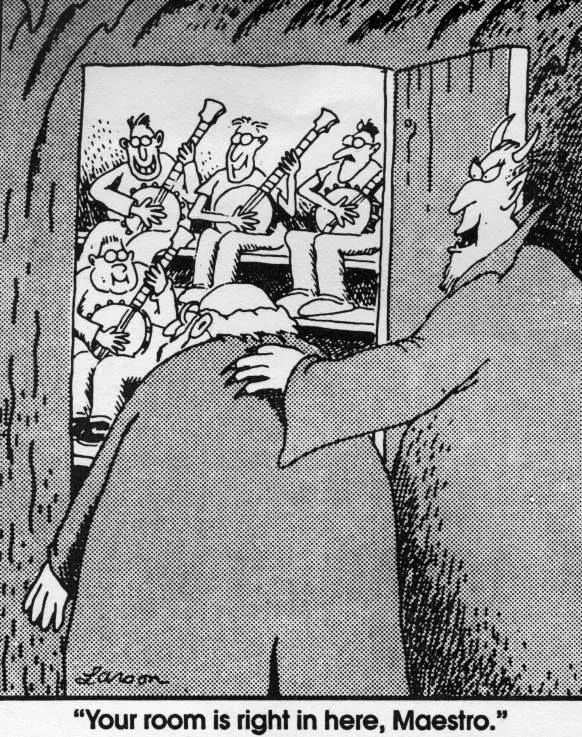
Speaking of the Most Precious Blood, I had occasion yesterday to ask Christ to wash with His Precious Blood the guy in the street – again – outside of where I was saying Mass all of a Sunday evening.   The same really bad musician this time had – I am not making this up – a banjo, instead of a guitar.  He was decidedly not a better banjo player than a guitar player.  The suspicious side of my character suspects that this was not an accident, especially given how it went last week.  As you may recall, I had ask the holy angels to quiet him while I said Mass.  As I passed him later he said, “The demon doesn’t like you.” (Al demonio non piace!).   In any event, I started Mass and he quieted down for a while, just to start up again right at the consecration.  I paused and renewed my plea and he calmed down again and was mostly quite for the rest of Mass.   Passing him by this time I heard a mumble, but nothing I could make out.

Yesterday I was out to lunch at a wonderful place near The Parish™.  Starting with tongue and pizza bianca with a wonderful herby green schmear and homemade mayo.  This we shared around.

Grama’s meatballs. The place is known for recipes that the owners grandmother made.

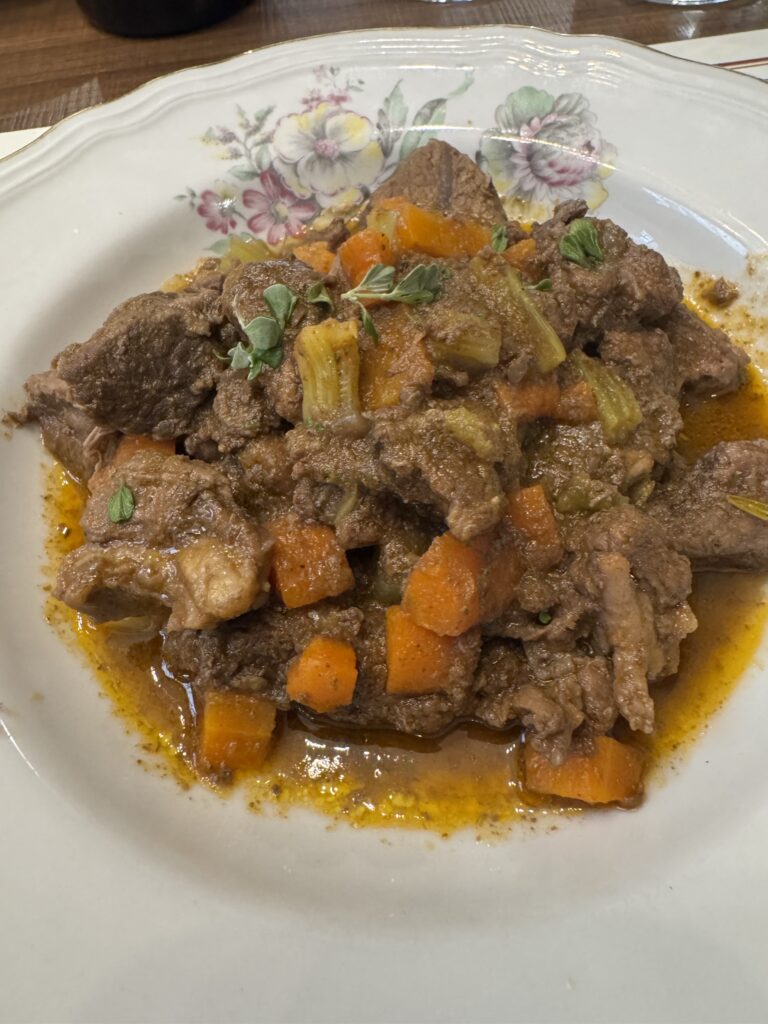
I had braised mutton. I spoke to the chef about it at length. It was in a marinade the day before. Some juniper and clove and wine. About 5 hours to braise, the last hour with a bay leaf and rosemary. It melted.

The side altar of Our Lady of Sorrows with The Parish™’s fine Crucifix.

What else can I tell you?

Today I am doing laundry. Also, I just got off the phone with the goldsmith’s shop. They are working on my paten (again). Aldo says it should be ready on Thursday or Friday. I’m betting Monday. Beati qui non expectant… and all that.

In churchy news… I don’t have much good to say about the walking together about walking togetherity going on over the river. This, however, is encouraging.

Also, Fr. Z follows Fr. V.

I had a nice note from the Summit Dominicans, the “soap sisters”, who make lots of other things as well including candles. They send candles for my chapel. Sister wrote to tell me that they earmarked a couple sets of ADVENT candles for me! Very sweet of them. I always think of them and say an Ave when I light my Advent wreath.

Advent isn’t that far off. Perhaps you should think about candles?

And this, just because I love St. Joan of Arc.

In chessy news … HERE

Upcoming sacrilege in Atlanta and Communion in the hand. Musings.

LifeSite reports that some foolish group in Atlanta will hold a “black Mass” during which a sacred Host will be desecrated.

The Archbishop of Atlanta has called for acts of penance, adoration and reparation. “Some” Catholic churches will have Mass to counter the sacrilege.  Two were named, one of them Byzantine and, therefore, not of the Archdiocese of Atlanta.   I hope there are more than two.

The bulletin of the Epiphany of Our Lord Byzantine Catholic Church in Roswell says (emphasis added):

“Jesus Christ cannot be harmed by any action of theirs, but we are responsible for allowing the Eucharist to be stolen and desecrated”….

It might be that those perpetrators of an extremely imprudent act have a Host because someone broke into a church and stole one or more.  It might be that they have a priest on their rolls who supplies them.

It might be that one of their number causally walked out of church with one because of Communion in the hand.

Byzantines don’t have Communion in the hand.

Yes, we Latins are responsible.   Steps should be taken always to safeguard the Hosts in our tabernacles and in their distribution at Communion.

If something is deemed important enough, then at least adequate if not superlative care will be taken.

Moreover, if we have correctly read the notices about the recent survey concerning faith if the Eucharist, the respondents themselves pointed to Communion in the hand as having been a factor in the Eucharistic faith.  They recommend that, to help restore reverence and faith in the Eucharist that Communion in the hand – and extraordinary ministers of Communion – be phased out.

Is this hard?   Given the stakes?


ACTION ITEM! GULF & FLORIDA BISHOPS, PRIESTS, LAITY: Pray the Litany against Hurricane “Milton”

Please retweet and share around.  The buttons are just up there… ? … see e’m?   

Hurricane Milton is coming.

It could be Cat FOUR.

Here’s an action item for you believing priests and bishops out there.   With confidence we can pray the prayers which the Church has designated against storms.

I believe what the Church believes.  Do you?

Therefore….

BISHOPS OF THE GULF COAST AND FLORIDA: Stand on the steps of your respective cathedral churches, dressed in cope and miter and, surrounded by clergy, with crosiers in hand, pronounce from the traditional Rituale Romanum the Litany of Saints with the deprecatory prayers against storms.  [below]   Ring the cathedral bells.

Bells are sacramentals.  They are “baptized” and given names.  They speak.  In valleys of mountainous countries, as storms approached, people would ring the bells and pray the Litany.  That’s one of the reasons why we have consecrated bells!

You all talk to each other: perhaps coordinate your timing.

I know that in every chancery at least one person reads this blog, probably more.  Readers, especially if you know your bishops personally, ask them to do this.

Look, you bishops out there… I know you are nervous about Rome frowning on you because you used a traditional book.  You don’t have to publicize it.  If you are nervous, do in it private.  BUT DO IT.

For the love of God and those in your charge.  Use the God given office and authority of a successor of the Apostles and PRAY DOWN THIS STORM!

PRIESTS OF FLORIDA: Ditto.  Also, if you have blessed bells, ring the bells of your churches against the storm.

LAY PEOPLE: Get on your priests about this.  The prayers of priests and bishop are powerful.  Also, ask your holy angels to protect you and to help you make prudent decisions.

Fathers, Bishops…

Use the old Roman Ritual (yes, the traditional book – you can do it! – it’s the real deal!) and pray the Litany with the deprecatory prayers against storms. A procession could be done around the grounds of the cathedral or even indoors… even with a very few.

You don’t have to be directly in the line of the storm to pray for others!  You don’t have to be in Florida!  

Fathers… Bishops… do this in Latin to be most effective.

PROCESSION FOR AVERTING TEMPEST [Better in Latin, but here is the English.]

The church bells are rung, and all who can assemble in church. Then the Litany of the Saints is said, during which – at the right moment, namely, after the invocation, “That you grant eternal rest to all the faithful departed, etc.”, the following invocation is said twice:

From lightning and tempest, Lord, deliver us.

At the end of the litany the following is added:

P: Our Father (the rest inaudibly until:)
P: And lead us not into temptation.
All: But deliver us from evil.
Psalm 147
P: Glorify the Lord, O Jerusalem; * praise your God, O Sion.
All: For He has strengthened the bars of your gates; * He has blessed your children within you.
P: He has granted peace in your borders; * with the best of wheat He fills you.
All: He sends forth His command to the earth; * swiftly runs His word!
P: He spreads snow like wool; * He strews frost like ashes.
All: He scatters His hail like crumbs; * the waters freeze before His cold.
P: He sends His word and melts them; * He lets His breeze blow and the waters run.
All: He has proclaimed His word to Jacob, * His statutes and His ordinances to Israel.
P: He has not done thus for any other nation; * He has not made known His ordinances to them.
All: Glory be to the Father.
P: As it was in the beginning.
P: Our help is in the name of the Lord.
All: Who made heaven and earth.
P: Lord, show us your mercy.
All: And grant us your salvation.
P: Help us, O God, our Savior.
All: And deliver us, O Lord, for your name’s sake.
P: Let the enemy have no power over us.
All: And the son of iniquity be powerless to harm us.
P: May your mercy, Lord, remain with us always.
All: For we put our whole trust in you.
P: Save your faithful people, Lord.
All: Bless all who belong to you.
P: You withhold no good thing from those who walk in sincerity.
All: Lord of hosts, happy the men who trust in you.
P: Lord, heed my prayer.
All: And let my cry be heard by you.
P: The Lord be with you.
All: And with your spirit.

Let us pray.
God, who are offended by our sins but appeased by our penances, may it please you to hear the entreaties of your people and to turn away the stripes that our transgressions rightly deserve.

We beg you, Lord, to repel the wicked spirits from your family, and to ward off the destructive tempestuous winds.

Almighty everlasting God, spare us in our anxiety and take pity on us in our abasement, so that after the lightning in the skies and the force of the storm have calmed, even the very threat of tempest may be an occasion for us to offer you praise.

Lord Jesus, who uttered a word of command to the raging tempest of wind and sea and there came a great calm; hear the prayers of your family, and grant that by this sign of the holy cross all ferocity of the elements may abate.

Almighty and merciful God, who heal us by your chastisement and save us by your forgiveness; grant that we, your suppliants, may be heartened and consoled by the tranquil weather we desire, and so may ever profit from your gracious favors; through Christ our Lord.

All: Amen.
He sprinkles the surroundings with holy water.

Bishops, priests!

You don’t have to advertise this or call in the TV cameras (though that would be great, too).  JUST DO IT.

C’MON!  What do you have to lose?

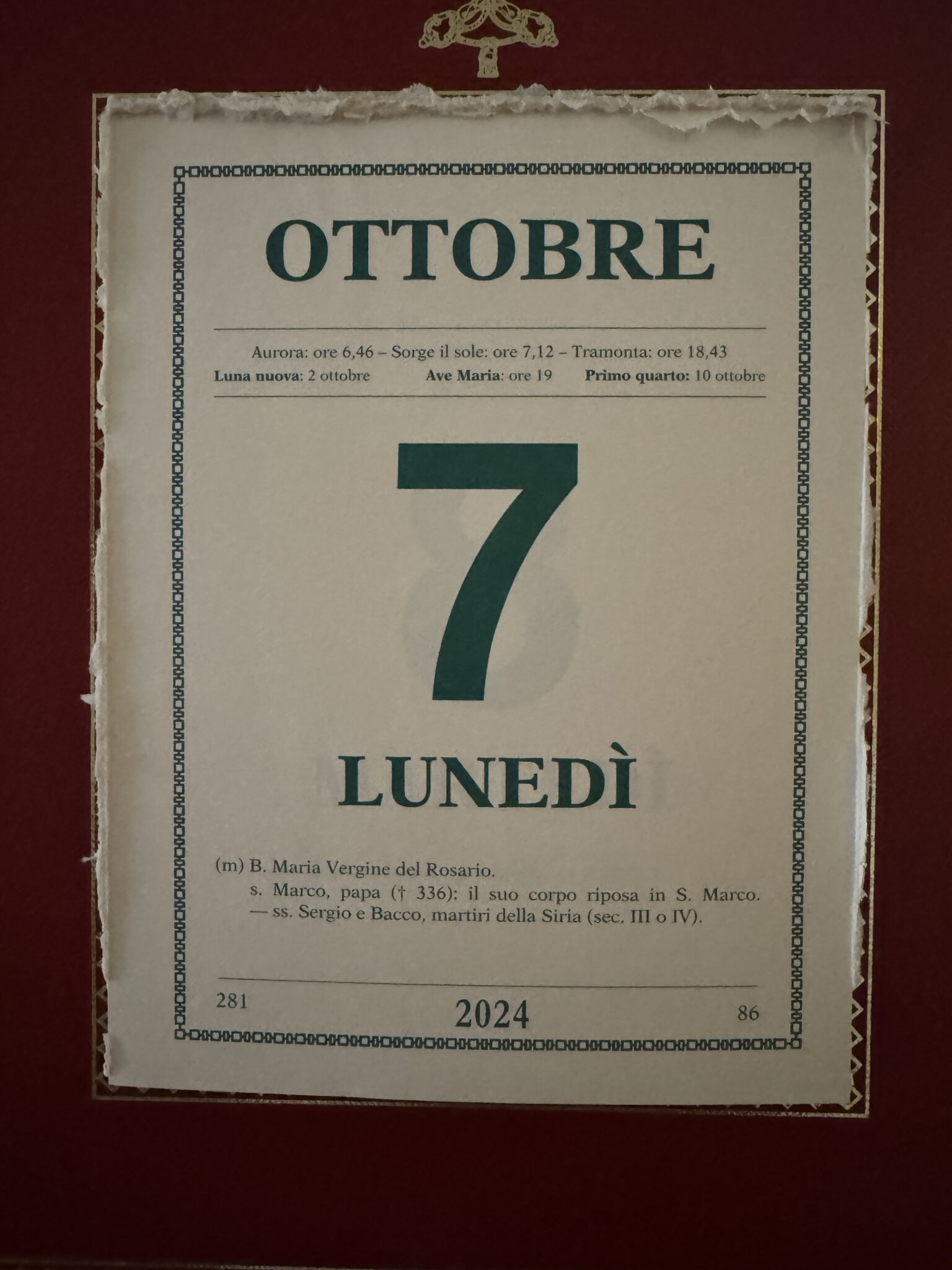
Rome 24/10 – Day 7: Our Lady of the Rosary

It was cloudy, but the sun probably rose on time at 7:12.   It will probably have to be take on faith (evidence of things not seen) that it will set at  18:43.

The Ave Maria Bells is set for 19:00.

Thank you, Lord, for this day.

Please remember me when shopping online and use my affiliate links.  US HERE – UK HERE  WHY?  This helps to pay for health insurance (massively hiked for this new year of surprises), utilities, groceries, etc..  At no extra cost, you provide help for which I am grateful.

Today is the Feast of Our Lady of the Rosary which means that it is also the anniversary of the Battle of Lepanto.   In Italian it’s: panto.

It is also the Feast of St. Mark, Pope, who died in +336.  He was one of the first who was not a martyr.  I think the very first was Miltiades.

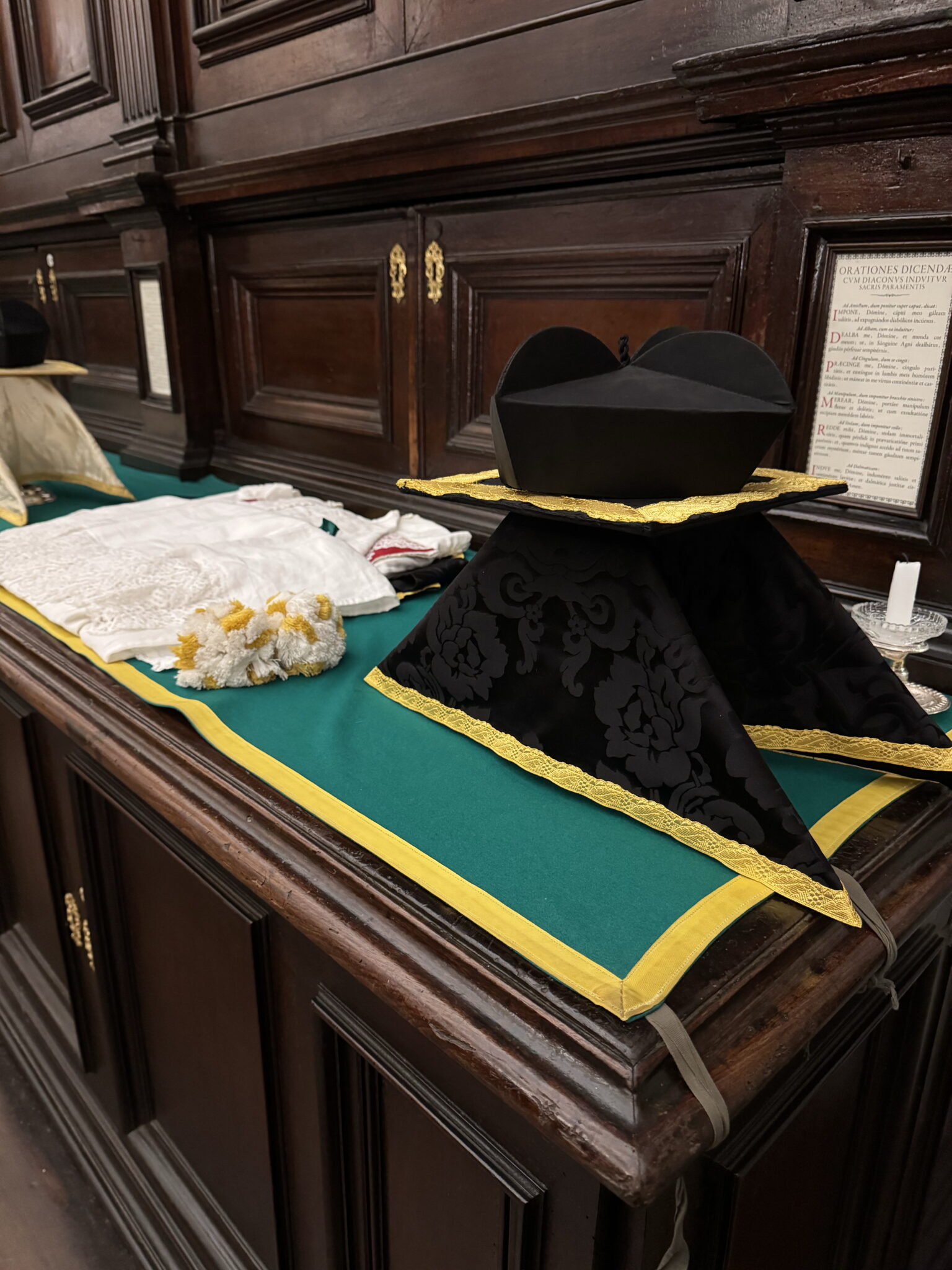
Here is a shot of one of the NEW black vestments laid out for one of the priests to celebrate a Requiem.   This is the one with my stemma.  What a pleasure to see it in use for the first time!

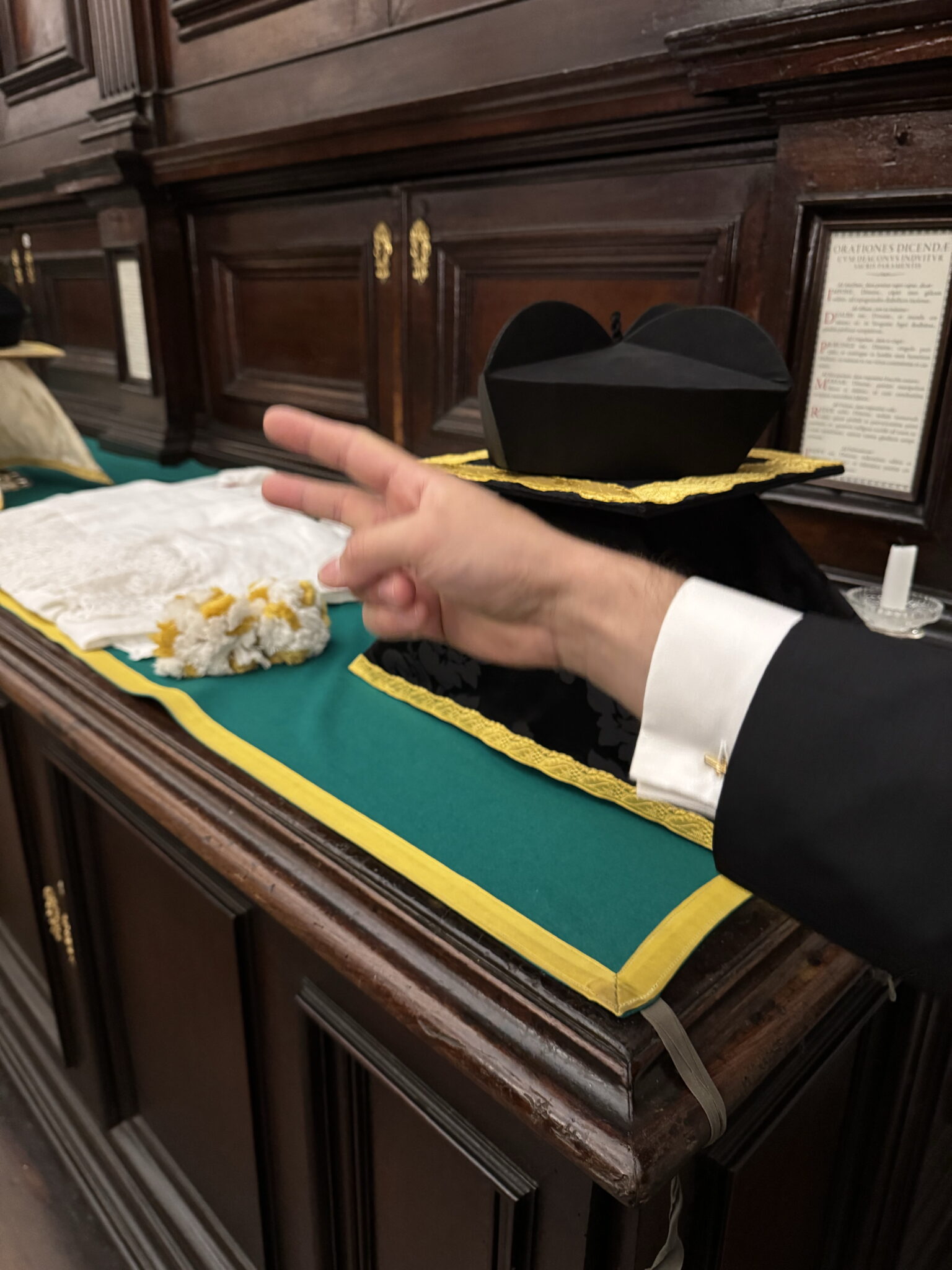
And this is The World’s Best Sacristan™ screwing around.

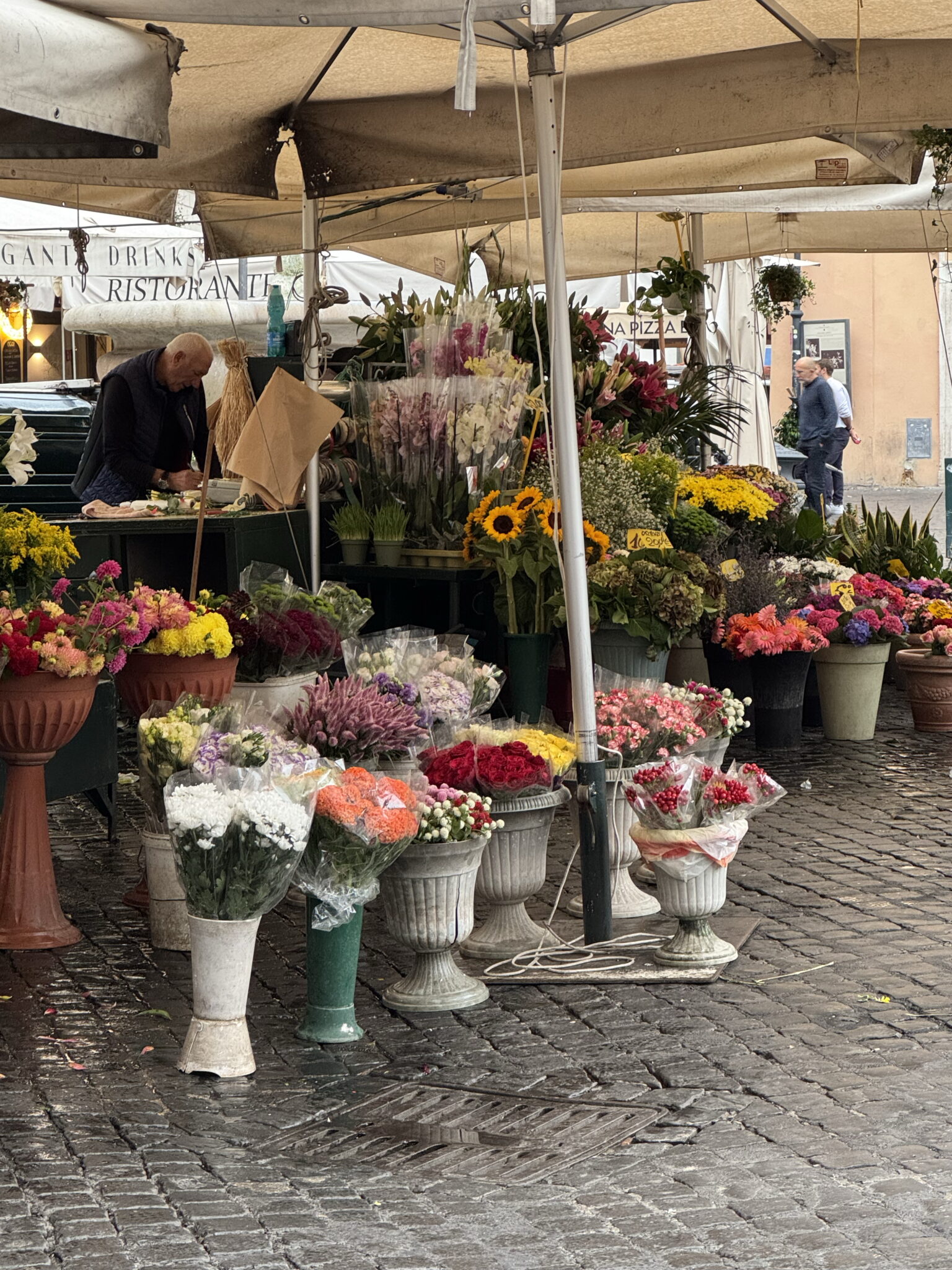
I had to consult with Pippo the florist today.  He assures me that there will be alstromeria soon.  However, I had to speak about 50 long stem yellow roses requested by friends who are coming to celebrate their 50th anniversary of marriage.  They want to give them to Mary at The Parish.  Nice.

Pippo, setting up.  You can say send him a note:  info@pippocampodefiori.com   You might say, “Ciao Pippo e Anastasia da uno dei lettori di don John!”

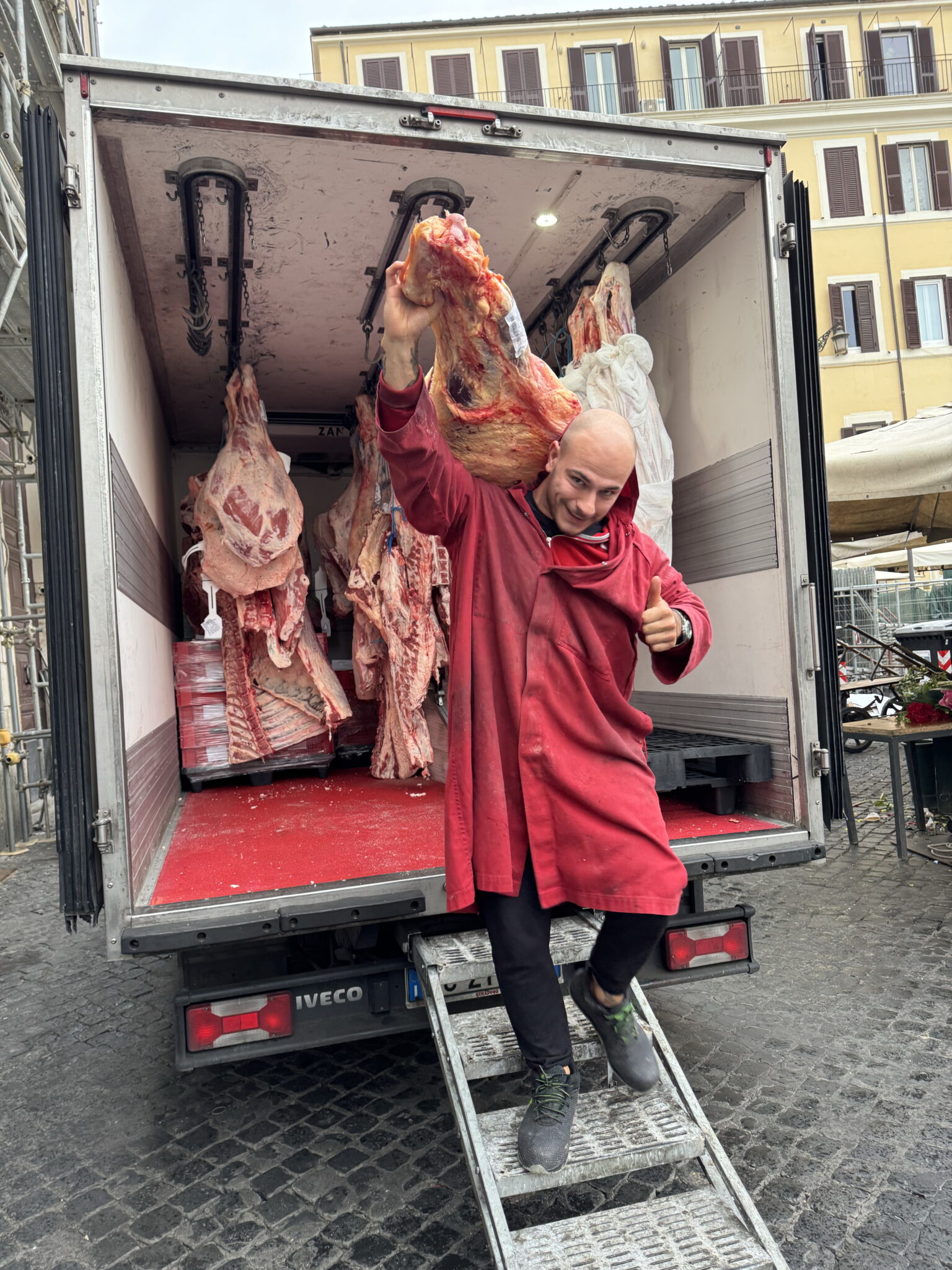
Then to the butcher, nearby.  Delivery in progress.

Rabbit… yum.

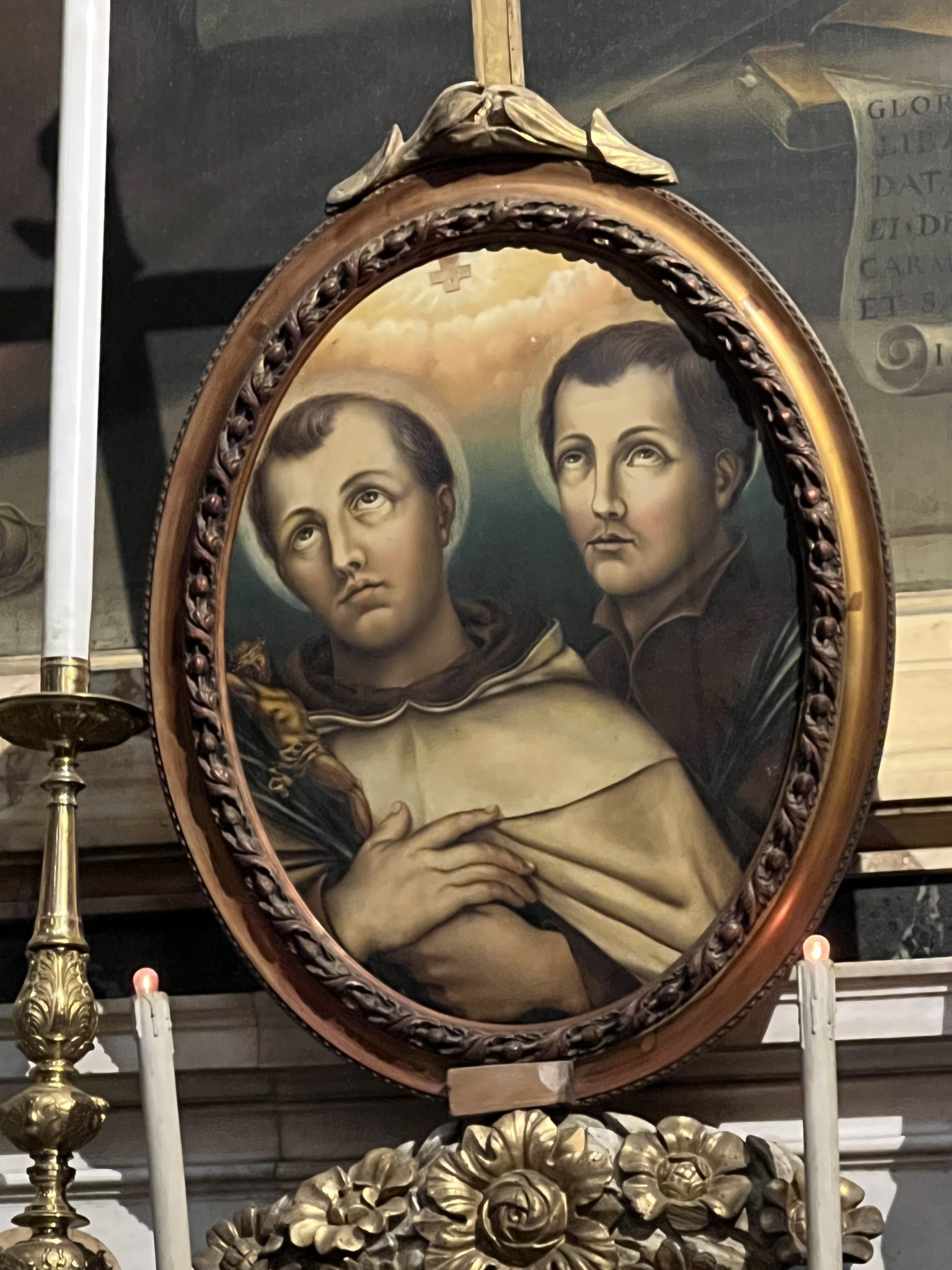
Today is the Feast of Sts. Sergius and Bacchus, early martyrs.  There is an image of them in the Church of St. Mary della Scala in Trastevere.  I’ve posted it before.  Not real flattering, I think.  It seems to me that both of them just saw …

… the consistory list.

It’s the eyes upward to Heaven that does it… or is it an eye roll?   Maybe it’s that.  An eye roll to Heaven.

Consistory list or maybe they are participants in the Walking Together about Walking Togetherity.

St. Sergio: “Please get me out of here?”
St. Bacco: “If I have to listen to this Jesuit one more minute…”.

Yesterday at the parish we had the Supplication to Our Lady of Pompeii.

And just for nice, from Holy Mass in the morning… external celebration of Our Lady of the Rosary (thus, white).

That leads to churchy news….

Yes, the list of new cardinals is out. Of those I know anything about, one is pretty good. One… an perhaps a subtle insult to the whole institution of the College and to us.

In chessy news… HERE

Hey Fathers!  How about a clerical Guayabera shirt?

1 July – Most Precious Blood and the Feasts of St. Junipero Serra and St. Aaron, brother of Moses

A thought for you:

Though we all may be different in height or sex or shape of eye and color of skin, we all bleed the same red Our Savior bled for our sins.

Our unifying human blood, divinely infused, courses ruddy within His risen veins, His glorious and still lacerated Sacred Heart!

What a powerful proof of the unity of our entire race.

Today is the Feast of the Most Precious Blood… in the older, traditional calendar of the Roman Rite.  Thus we inaugurate the month of July, during which in a special way, fire up our devotion to the Most Precious Blood of the Lord.

Every even tiny drop is worth the salvation of the souls of everyone who has ever lived.

While many have and will accept the gift Christ won by the pouring out of His Precious Blood, not all will.

Here is the Collect:

Omnípotens sempitérne Deus, qui unigénitum Fílium tuum mundi Redemptórem constituísti, ac eius Sánguine placári voluísti: concéde, quaesumus, salútis nostræ prétium sollémni cultu ita venerári, atque a præséntis vitæ malis eius virtúte deféndi in terris; ut fructu perpétuo lætémur in coelis.

Here is someone else’s translation:

Almighty, eternal God, Who made Your only-begotten Son the Redeemer of the world, and willed to be reconciled by His Blood, grant us, we beseech You, so to worship in this sacred rite the price of our salvation, and to be so protected by its power against the evils of the present life on earth, that we may enjoy its everlasting fruit in heaven.

And… by the way… today is also the feast of St. Aaron, brother of Moses.

Some people may not realize that many great figures of the Old Testament are considered saints and are listed in the Roman Martyrology.

Here is his entry in the 2005 Martyrologium Romanum:

1. Commemoratio sancti Aaron, de tribu Levi, qui a Moyse fratre oleo sacro unctus est sacerdos Veteris Testamenti et in monte Hor depositus.

Who wants to translate this for the readers?

Also, today is the, in the Novus Ordo calendar, the feast of St. Junipero Michael Serra Ferrer, whose memory is being attacked, sacrilegiously, these days. I was so pleased when Archbp. Cordileone read the Title XI, Chapter 3 exorcism at Golden State Park where the demoniac influenced mob tore his statue down.

Here is his Collect (Notitiae 269 Vo. 24 (1988) p. 928:

Deus, cuius ineffabili misericordia plurimas Americae gentes Ecclesiae tuae per Sanctum Iuniperum Serra, aggregare dignatus es; da nobis, eius intercessione, ita corda nostra tibi in caritate coniungere ut imaginem Unigeniti Filii tui coram hominibus semper et ubique portare valeamus. Qui tecum vivit et regnat.

30 June 2024: What’s going on?

As I write, there is a big problem with the back end of the blog, what is “under the hood” that drives it. It has to do with the WordPress engine and data base. The wonderful people who give me tech support are “coincidently” hampered from assisting. No blame to them. Circumstances are too amazing.

Blog problems cropped up on the Vigil of the Feast of St. Peter and Paul. I noticed that the blog’s admin was slow. On the Feast itself, worse. Today, Sunday but the Commemoration of St. Paul, but the 6th Sunday after Pentecost.

In this period, there was a consecration of the new Abbot of the traditional Benedictine monastery in Norcia, Italy. It was the first elevation of an abbey in Italy since the 1960s. That says a lot about the life of the Church in Italy. My main blog tech fellow is an oblate of that abbey and he went to the consecration of the new Abbot. Therefore….

In this last 48 hours or so, I lost all audio settings on the laptop that handles the live stream of my Masses. I fought with it for a couple hours (after midnight), which screwed up my next day. Then I had internet problems. The problems with the blog were underway. Today, when I tried to print out notes for days Mass (I read the readings in English and give a fervorino), neither of my printers would work.

Not only that, although I just managed to replace the roof on my house (which I wouldn’t have had to do were I not treated so well by a certain bishop, leaving me financially devastated – thanks, I pray for you), I have now found other difficulties that require some urgent attention precisely in the place where my home chapel is. I am not sure, but I may have related that I am pretty sure I and this place are under siege. When I had the place painted, I anointed the walls with chrism before the painting and put Miraculous Medals and St. Benedict Medals in the nooks and crannies before the place was refloored. A priest friend of mine who is an exorcist helped me do a dual exorcism of the place. However, I keep getting indications of affliction, including one day when I entered the chapel to say Mass for the anniversary of the death of a prominent Catholic figure, and a frog was sitting on the altar.

Get the picture?

Someone doesn’t like me.

Writing this will surely bring more problems. PERSEVERE.

Friends, the axe will be falling again soon and more people will suffer. I address myself to them.

Do NOT NOT NOT waver in your dedication to being a faithful Roman Catholic. NEVER. Do NOT for a moment consider orthodoxy (massively dysfunctional and NOT the Church Christ intended). Never give up! Never Surrender!

Tech.

However, I had already determined, in light of what I am hearing about a potential document attacking people who want the Vetus Ordo – while I now believe based on what I hear will indeed come on 16 July, the Feast of Our Lady of Mount Carmel (again) – is not only aimed at diocesan priests (guys like me, though I’ve been partially cancelled) it is aimed at bishops. I believe that they are going to be forbidden to use the Pontificale Romanum.

This is sacramental contraception.
In view of what I think is on the way, I had intended to post for the Feast of the Most Precious Blood – 1 July – an urgent plea for prayers for defense of the Traditional Latin Mass. I wanted to urge people to take action now for home chapels and to network with the priests.

I’ll postpone some other comments about what I think is going on. This is the auxiliary bridge.

I ask prayers for the protection of the Holy Angels from spiritual and temporal harm.